
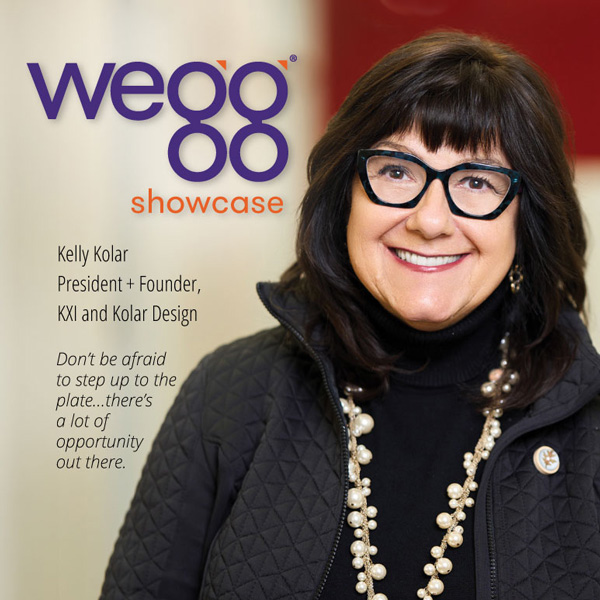
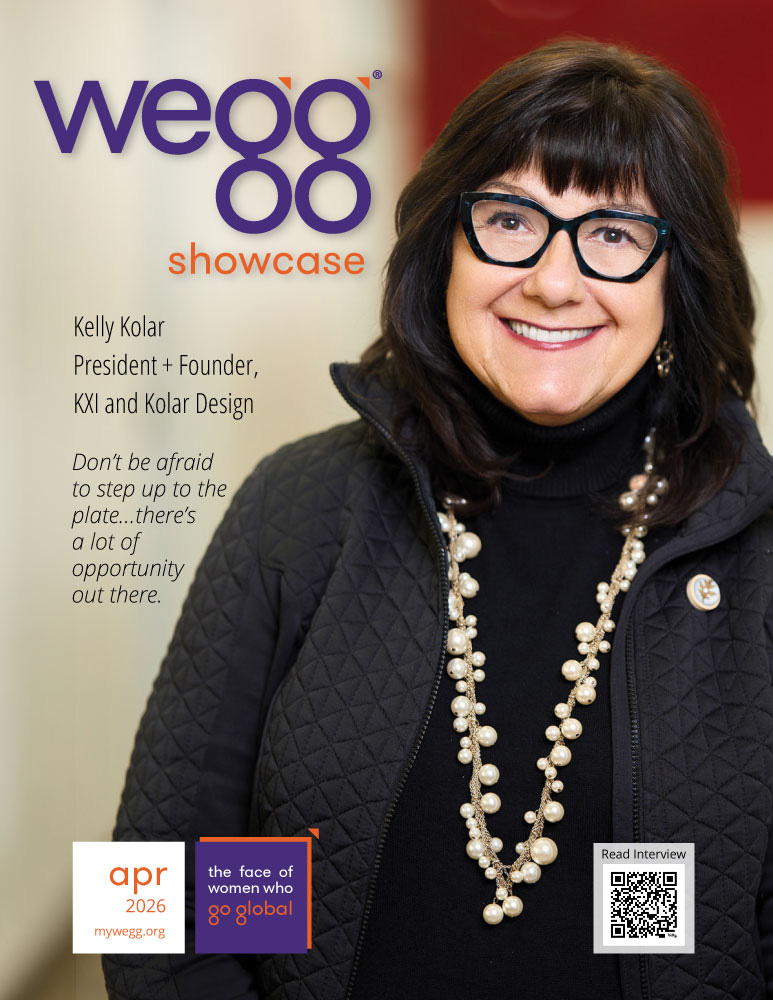
wegg® showcase: Kelly Kolar, President + Founder of KXI and Kolar Design
- Posted by Asra Khan
- Categories Featured, Scale, wegg® showcase, weggs
- Date March 27, 2026
Issue 23: April 2026
Sponsored By: 
Tell us a little bit about your business and what inspired you to start it.
I started Kolar Design 35 years ago after attending the University of Cincinnati, where I studied at the intersection of design, art, architecture, and planning. After our team won a design competition to create the look for the City’s Bicentennial celebration, I was hired to bring the civic brand to life. It was a great opportunity to build connections, and fall in love with the City I call home today– and home of my two companies.
As a daughter of an entrepreneur, I knew I wanted to follow in my father’s footsteps. I had my first “aha” moment during a Bicentennial event when I experienced how the power of design could shift the paradigm around culture tourism and help our citizens understand who we are, where we’ve been, and, more importantly, where we’re going. I knew then that I wanted to focus on creating magical moments at the intersection of people and places to build communities.
Today, the work we do at Kolar Design meets at the intersection of urban planning, architecture, brand, and interiors. It’s called branded experiential design.
Our vision is to harness the power of design to change lives. One of our earliest clients was Cincinnati Children’s, the number one pediatric institution in the country. We’ve been transforming the brand by creating spaces people love for 25 years now, and can prove it by measuring the impact of place on patients and families.
Then, in 2004, I started working with Procter & Gamble. P&G was already an international company, but its then-CEO A.G. Lafley wanted Procter & Gamble to go from being the name behind the manufacturing of billion-dollar brands to being a household name on the global stage. We started by bringing the Pampers baby care brand to life at headquarters. P&G was going through a brand transformation, and we then had the privilege and honor of designing the global headquarters to reflect the company’s mission, vision, and values, which is touching lives, improving life. Our job was to translate the brand into the built environment and establish guidelines—that’s our specialty. Over two decades, we worked in 17 countries, reflecting the soul of the company to its users, its communities, and in the key markets around the world.
I founded a second company last year called KXI, or Kolar Experience Innovations. The new company measures corporate workplaces to optimize human experience, brand, and ROI on investment. It also provides training and change management strategies to help teams build culture in their space. The global architect whom I worked for while helping P&G, Serge Bruylants, is now part of our team at KXI. Together, we worked to embed P&G’s culture and brand in each of its headquarters—from Kobe to Seoul, Paris, Rome, Jakarta, Indonesia, Singapore, and Beijing —while maintaining the uniqueness of each region’s culture.
What did you learn as you expanded your international footprint?
I learned that you need to have organizational readiness and operational efficiency. If you want to continue working internationally, you need to create a different, sustainable model. For example,
I started a joint venture in Singapore with another design firm because I needed to have local representation. Kolar Design completed the first phase of a large project, but ultimately, the partner couldn’t deliver the work. We finished the project, but we exited that partnership.
From there, I located some important resources for finding a partner that could co-deliver with us in global markets. One resource is WEConnect International. I also attended education sessions held by EXIM Bank through WBENC. If you’re thinking of exporting, there are a lot of resources the U.S. government provides for securing funding, exporting a product, helping with contracts and payment, or finding and vetting legal, financial, and institutional partners.
What advice would you give women entrepreneurs hoping to take their business global?
Find trusted partners. Go to market by co-delivering through contracting. Do small tests of measure to build your success. Baby steps first. Then, as you get closer, create a joint venture. You need to right-size the partnership as the business evolves, so you and your local partner can grow together.
Also, have a clear business plan and understand your financial needs. Working in different denominations can be complicated. How can you leverage your bank or EXIM Bank to guarantee your contract and take the risk off the table for you? Readiness is the second biggest component. You have to be ready to answer the question, “What happens if?”
Finally, you can put all kinds of systems and protections in place, but sometimes things just happen. You have to be able to get into the game of business. Don’t be afraid to step up to the plate. If you’re thinking about going global, you can definitely grow globally, because there’s a lot of opportunity out there.
Tag:wegg showcase

Asra Khan is wegg's Newsletter and Special Projects Manager. As a creative force, her focus has been dedicated to amplifying the voices of women and Asians within the realms of art, entertainment and education.