

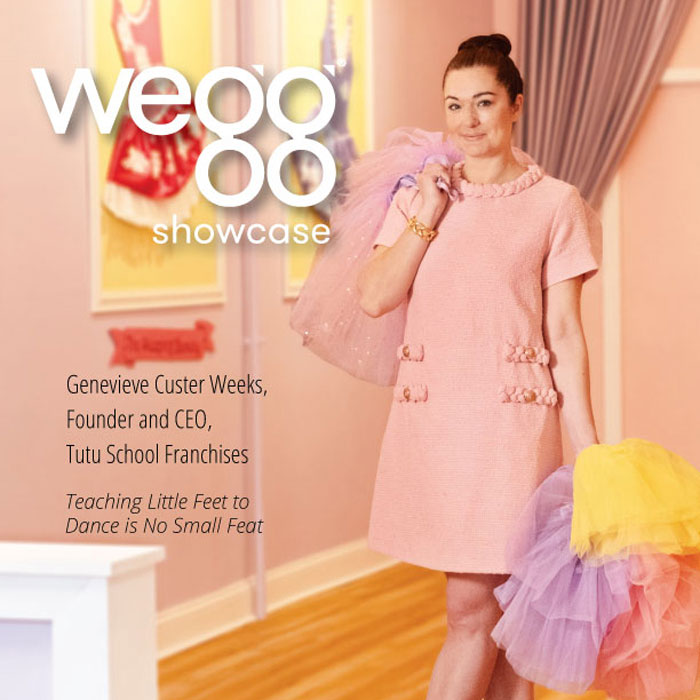
wegg® showcase: Genevieve Custer Weeks, Founder and CEO of Tutu School Franchises
- Posted by Asra Khan
- Date February 2, 2026
- Categories Featured, Scale, wegg® showcase, weggs
Issue 21: February 2026
Sponsored by: 
Tell us about your business and what inspired you to start it.
I’m the founder of Tutu School, a collection of boutique ballet schools for very young children. I started it 18 years ago in San Francisco. I joke that it takes a very special type of personality to do this, because teaching ballet to three-year olds is a lot like herding squirrels!
I was dancing professionally at the time and between gigs taught at schools in the San Francisco Bay Area. One school put me in charge of their pre-ballet division, and I fell in love with teaching kids that age. Whether they were going to dance seriously or not, there was something magical about putting children in a room with music and movement.
At the same time, the entrepreneurial part of my brain saw that as much as I loved them, the dance schools I grew up in and taught at were not doing it very well. Teaching three-year-olds on a Saturday morning was treated as an afterthought. Classes were held in cavernous warehouses, dingy spaces that are intimidating for a little kid going in for their first ballet class. And even with the best of intentions, teachers haven’t been given developmentally-appropriate training on how to work with really little ones.
I started thinking: what if there was a program where teaching ballet to little ones was all it did? My husband and I found a little room in San Francisco and that’s where we started the first Tutu School. I opened another one 18 months after that, across the Golden Gate Bridge in Marin. A few years later, we started looking into franchising. Today, there are 145 Tutu School locations, and two of them are international.
When you started setting up franchises internationally, did you encounter any challenges?
Definitely. We had to navigate cultural and market fit differences. It’s important that our brand voice is authentic, but something like using a spelling that is not a Canadian spelling is not going to feel authentic to a Canadian community. Since our school is in North Vancouver, things like that are really important to us. It’s also important that they feel it’s their Tutu School, that their experience does not feel like part of a chain. It sounds like a small thing, but it can impact a community’s experience of the school.
It has been a cultural shift going into the UK with something different, even for very little children. Dance is something a lot of kids do In the UK, but they are used to a more formal program where you graduate between levels and there are exams. Then there are practical things like rules governing data privacy. In the UK, whether you’re opening one school or fifty, you have to comply with their data privacy regulations, or GDPR. We underestimated how much of a heavy lift that would be just to launch our first little studio there.
What countries are you targeting next and do you anticipate any issues entering them?
Our new Chief Growth Officer, Ali McElroy, comes from a franchise background and has specific experience in franchising internationally. She has a ton of experience in Australia and New Zealand, and there’s real interest in the Tutu School concept there. Also, our Seattle owners are professional dancers and moved to Europe to dance. They would like to open up a Tutu School there. They’re currently in Monaco, and we’re exploring what that could look like.
Our growth thus far has been based on interest, from people finding us. That’s what’s been happening internationally, too. In our next phase, we want to be more targeted and strategic. For example, what makes the most sense in franchising is to look at some sort of master franchise situation, where we would find somebody to help franchise Tutu Schools within whatever country we’re entering.
What advice would you give women entrepreneurs, specifically those who are looking to build their businesses through franchising and want to expand internationally?
Internationally, you have to look for good partners, especially if you’re entering a completely new market. You have to trust that your partners will represent your brand there. There also has to be two-way trust because we’re going to be learning together. We said no to many who wanted to take the Tutu School concept into countries we weren’t ready to go into, and said yes to the partners in UK and Canada because we really trusted them.
I’ve become an evangelist for franchising. It’s an incredible way to scale without taking on a lot of outside funding because your franchisees become your investors. It’s something I encourage all founders to look into, and especially female founders, who have been historically shut out of some of the traditional methods of fundraising. Even if you end up not franchising, you will never regret setting your business up to franchise. The exercise you go through to make your company and your concept scalable will make your business better, no matter what.
Tag:wegg showcase

Asra Khan is wegg's Newsletter and Special Projects Manager. As a creative force, her focus has been dedicated to amplifying the voices of women and Asians within the realms of art, entertainment and education.
You may also like

Black Business Month 2026